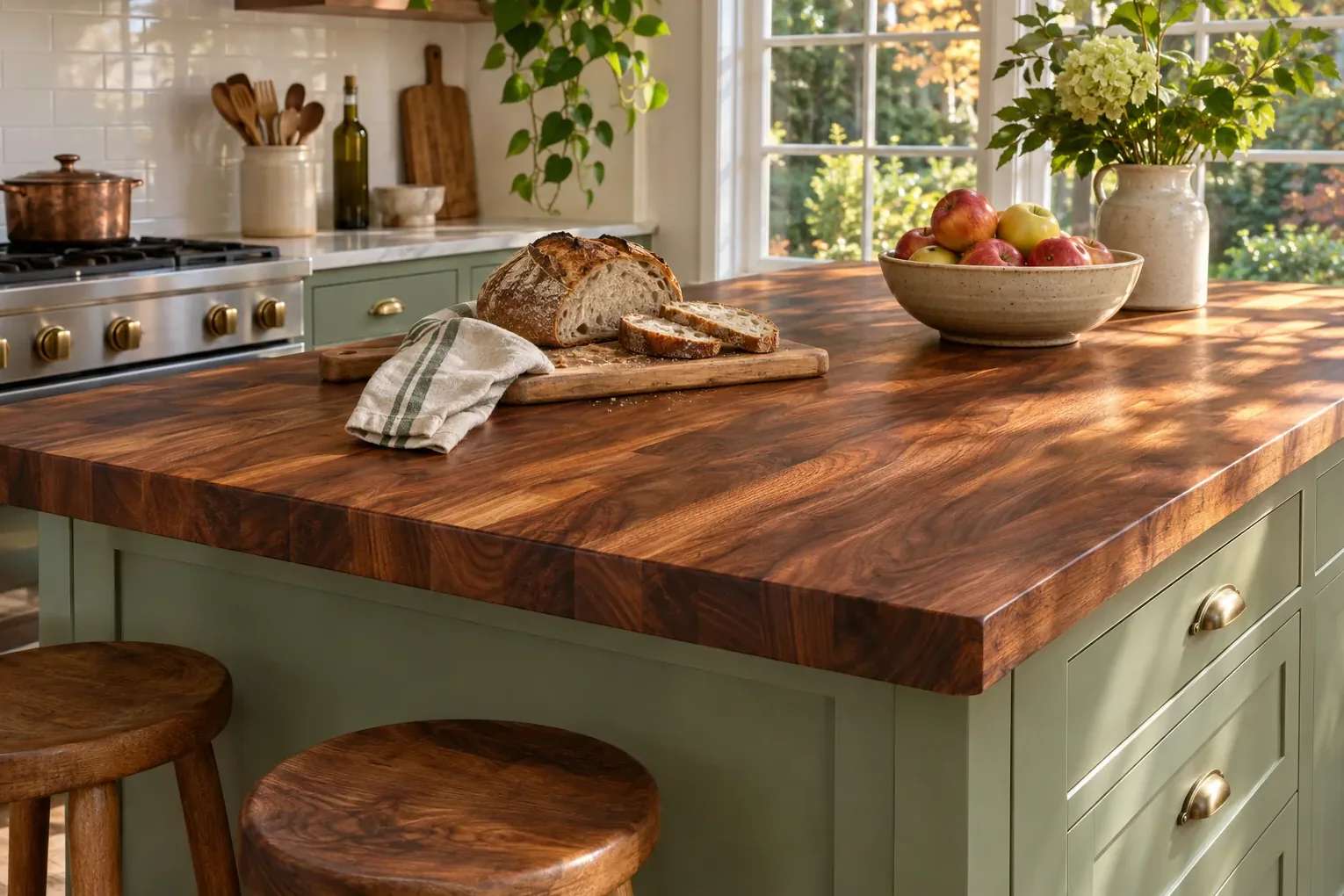
Butcher Block Countertops in Rockford, IL
Get a free quote
We reply with a price. Nothing is booked until you say yes.
Updated
What to expect
Our butcher block countertop service
Butcher block is wood counter stock, glued up from strips of hardwood. It is warm, it can be sanded and refinished, which stone cannot, and it costs less than most stone. Here is what a butcher block job with us includes:
- Measuring the kitchen and helping you pick species and grain
- Letting the wood sit in your kitchen to settle before it goes in
- Sink cutout, edge and finish, with every cut edge and the underside sealed
- Fastening the top so it can move with the seasons, never glued down
- Oiling the top before you use it
- Removing the old top, in or out of the price, in writing
The whole material choice is on countertops.
Butcher block countertop cost per square foot
Installed butcher block typically runs between $18 to $38 and $30 to $70 per square foot, with some quotes reaching $20 to $70.
| Material | Installed per sq ft |
|---|---|
| Butcher block | $18 to $38 per sq ft |
| Butcher block (higher end) | $30 to $70 per sq ft |
| Butcher block (top of range) | $20 to $70 per sq ft |
| Laminate, for comparison | $8 to $35 per sq ft |
| Quartz, for comparison | $15 to $70 per sq ft |
Wood sits between laminate and most stone. A sink cutout and the finishing still take skill, so the labor is in the price. For the whole job in context, see the kitchen remodel cost page, and for a tight budget the budget kitchen remodel page.
Oil or a sealed finish
This is the real choice. A penetrating oil (food-safe mineral oil) soaks in, keeps the wood food-safe, and is easy to renew, but it needs regular reapplication, especially near the sink. We do not use stain on food-prep areas.
A film finish, such as polyurethane, forms a hard seal on top. It resists water better and needs less upkeep, but you do not cut on it without marking the film, and a scratch means refinishing the whole piece. Many people use oil on an island where they chop and a film finish where water lands. Either way we finish the underside and the sink cutout edges too, because wood that is sealed on one face moves unevenly.
Butcher block near the sink
Standing water and wood do not mix. Water gets into the end grain at the cutout and the wood swells, darkens and can split. We oil the inside and bottom of every sink cutout so water cannot soak in. Wood by the sink is a commitment. If you do not want that, use stone or laminate at the sink and wood elsewhere. An undermount sink on wood needs an extra sealing step. See kitchen sink replacement.
Why the island is the best place for wood
An island usually has no sink and sees the knife, the cutting board and the kids homework. It is also what people see first. A wood island against stone or painted cabinets is a classic pairing, and it keeps the wet work on a hard top. See the kitchen island page for layout and support, since a deep overhang needs brackets. We set brackets every 24 inches when the overhang is more than 8 inches across the grain or 12 inches along the grain.
Butcher block vs the other counters
Wood is warmer and quieter than stone and can be sanded, but it is softer, it moves with the seasons, and it asks for regular care. Laminate is cheaper and needs less upkeep but scorches and chips. Quartz and granite resist heat better and need less attention by the sink. Wood is a good fit when you cook a lot at the island, want a natural look and will keep up with the oil. It is a poor fit when the kitchen is rented, the house sits empty for months, or nobody will do the upkeep. See countertops for the full comparison and quartz countertops if you decide against wood.
Choosing the wood and the grain
There are three constructions. Edge grain is long strips glued side by side, and it is the most common and the most affordable. Face grain shows the wide face of the boards. End grain turns the strips on end for a checkerboard look that is gentler on knives and costs more. Species changes the look and the hardness. We recommend dense hardwoods such as maple, cherry, walnut or oak. Pick a species you like to see change, because wood darkens and ages. Solid strips at full length are less likely to show seams than shorter pieces joined end to end.
Buying a raw slab from a lumber supplier can lower the material cost, but it moves the work to you: cutting to length, the sink cutout, edge shaping and finish. When we fabricate and install, the labor is in the price.
How we install butcher block
- It acclimates first. The wood sits in the room for about 48 hours so it stabilizes.
- It is not glued down. Adhesive can keep the wood from shrinking and expanding. It is screwed up through the cabinet braces with pilot holes, so the screw does not go through the top.
- Dense hardwood only. Maple, cherry, walnut or oak.
- Finish goes on before it goes in. The underside, edges and cutouts are easy to reach on sawhorses and hard to reach after.
Mixed surfaces on one run
Using two materials is common. The usual split is stone or laminate on the perimeter, where the sink and range sit, and wood on the island. You spend where wear is highest and keep the warm look where people gather. We match the finished height of both tops, since thicknesses differ and a step between them looks off, or we make the change at a deliberate spot such as a corner or an end panel. The order is cabinets first, then each top.
Cutting, sanding and finishing wood
Wood is easier to work than stone, so the sink opening, the rounded edge and the fit happen on site. It makes sawdust, which is a nuisance and not the same hazard as stone dust, but we still run a mask and a vacuum indoors. Every cut edge is sealed the same day it is made, since fresh end grain drinks water. We sand through the grits in order, wipe the dust before the first coat, and apply oil in thin coats, letting each soak and wiping the excess.
Everyday care and repairs
Wipe the top with a damp cloth and mild soap, dry it, and keep standing water off. Do not leave a wet sponge or a dish rack on it. Set hot pans on a trivet, since heat can mark the finish. Small marks can be sanded out with fine paper and the spot re-oiled. A deep stain or a dark water ring near the sink usually means the finish failed there, and the fix is to sand and refinish that section, not to oil over it. This is the real advantage over stone: a wood top can be renewed, where a chip in stone is a repair call.
Wood with the rest of the kitchen
Wood pairs with stone: see quartz countertops and granite countertops for the perimeter. Rockford lists cabinets and tile as exempt finish work and does not name countertops, and Machesney Park says cabinets and countertops need no permit. A sink move is plumbing and needs a permit.
Want a straight price on yours?
Call, text a photo of the kitchen or of a quote you already have, or send the form. The price comes first, in writing.
Questions people ask
How much does butcher block cost per square foot?
Installed butcher block runs $18 to $38 per square foot at the low end, $30 to $70 in the middle, and up to $20 to $70 on some quotes. See kitchen remodel cost for the rest of the job.
Is butcher block a good idea in a kitchen?
It works well on an island and for people who will oil it. It is a poor match for a sink wall unless you are strict about sealing and drying. Many kitchens put wood on the island and stone or laminate at the sink.
Should I seal butcher block with oil or polyurethane?
Food-safe mineral oil is the common pick on prep surfaces and needs regular renewal. A film finish resists water better but is harder to repair. We seal the underside and cutouts either way.
Can butcher block go around a sink?
It can, if every cut edge and the sink cutout are sealed and you dry standing water. We oil the inside and bottom of the cutout. Otherwise use stone or laminate there.
How long should butcher block sit before install?
About 48 hours in the room so it acclimates. Do not glue it down, since wood needs to expand and shrink with the seasons.
Can you refinish butcher block?
Yes. Light wear and scratches can be sanded and the finish renewed, which stone cannot do. A film finish means stripping and redoing the whole surface.
Keep reading
Butcher block countertops: get a written price
Tell us what you want to change and your town. We reply with a price, and no work starts until you agree to it.
Prices and the full service list are on the homepage for kitchen remodeling in Rockford.