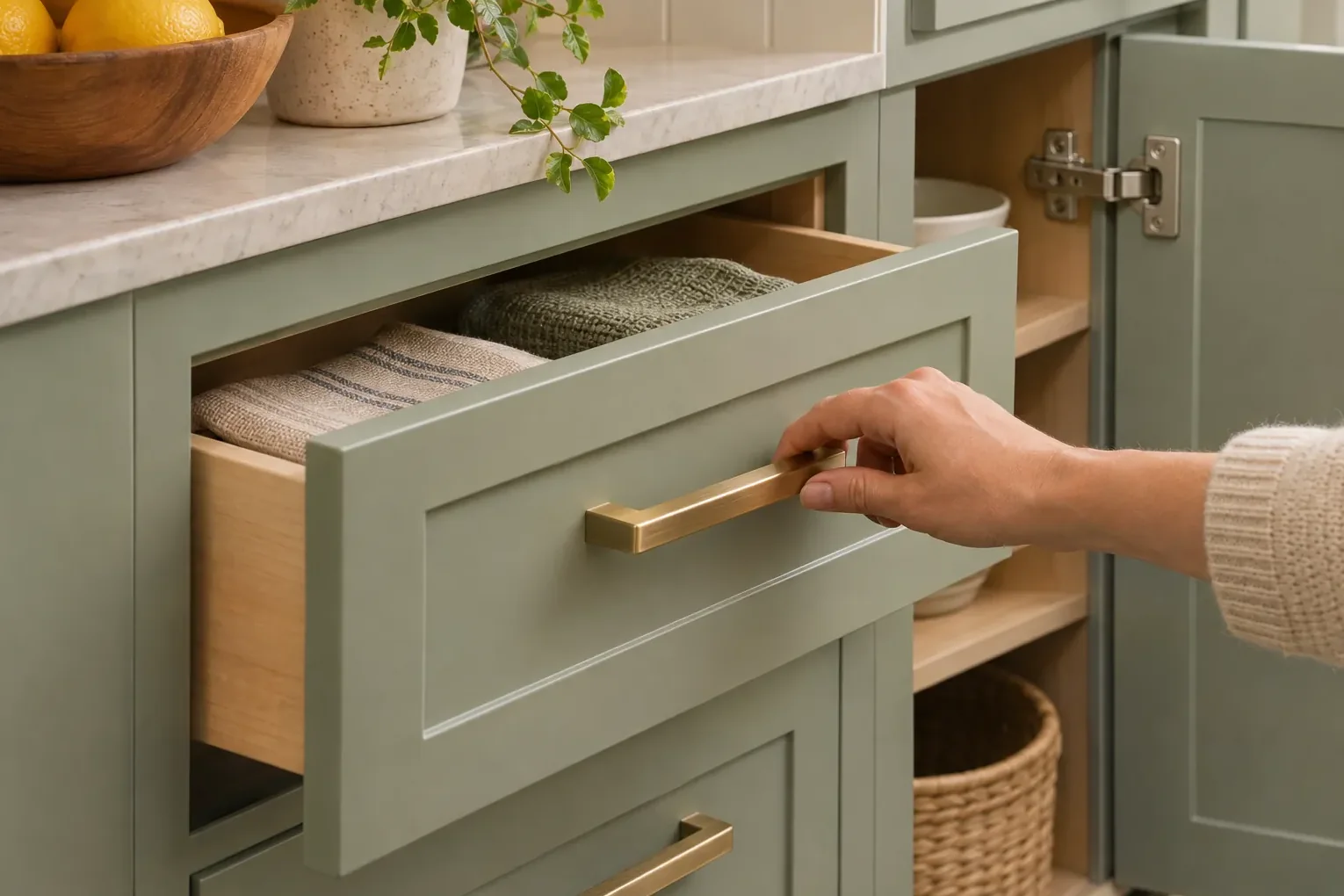
Kitchen Cabinet Hardware: Pulls, Knobs and Hinges
Get a free quote
We reply with a price. Nothing is booked until you say yes.
Updated
What to expect
Our cabinet hardware service
Hardware is the cheapest upgrade in this group that you feel every day. The decisions are small: pull or knob, how long, where it goes, and whether the hinges close softly. Getting them right takes a tape measure and a template. Getting them wrong leaves extra holes in a door you just paid to paint. Hardware usually goes on with cabinet painting or cabinet refacing, when the old holes can be filled or the new fronts drilled fresh.
Here is what hardware work with us includes:
- Measuring your existing holes so the new pulls match
- Pull and knob placement set once and repeated on every door and drawer
- Every hole drilled through a template, never by eye
- Old holes filled and sanded if the spacing changes
- Soft-close hinges or add-ons where your doors can take them
Pull sizes: measure center to center
A pull is sized by the distance between its two screw holes, measured from the center of one hole to the center of the other. That is not the overall length of the pull, which is longer. The sizes most common in modern kitchens are 3 inch, 96 mm (3-3/4 inch) and 128 mm (5-1/16 inch). The 96 mm size comes out to about 3.78 inches, which is why it is sold as 3-3/4 inch.
| Hole spacing | Also written as | Where it commonly goes |
|---|---|---|
| 3 inch | 76 mm | Small drawers and upper doors |
| 96 mm | 3-3/4 inch | Doors and medium drawers |
| 128 mm | 5-1/16 inch | Wide drawers, pot drawers |
Hold a pull against the door before you drill. The point that matters when you are replacing pulls: 3 inch and 3-3/4 inch pulls are not interchangeable. Their holes sit about 3/4 inch apart, so switching from one to the other means filling the old holes and drilling new ones. Measure the holes you have before you shop. If you want to keep the doors as they are, buy the same spacing.
Knobs, pulls or both
Knobs go on a single hole. Pulls need two. A common pattern is knobs on doors and pulls on drawers, but it is only a pattern. Pulls are easier to grab with wet or full hands, and wide drawers read better with a pull than a lone knob. Whichever you choose, use the same finish across the room, and match it to the faucet or the lighting if you want the room to read as a set.
Where we put them
The usual rule: on upper doors the hardware sits 2 to 3 inches up from the bottom edge, on base doors 2 to 3 inches down from the top edge, and a single pull on a drawer goes at the center of the front. We pick one spot and use it everywhere so the kitchen reads as one set. Hardware goes on the edge of the door away from the hinge.
Drilling templates
We drill every hole through a template or a jig, never by eye. A cheap template is a strip of cardboard or a simple adjustable jig, and it puts every hole in the same place. The method:
- Decide the spot once, on one door. Measure it, and write the numbers down.
- Set the jig or the cardboard template to that spot and tape it at the corner.
- Put painter's tape on the door face to stop the bit from tearing the finish.
- Drill through the template with a bit matched to your screw. Back the door with a scrap board so the exit side does not blow out.
- Test the screw length. A screw that is too long pokes through the front of the door.
Hinge types and soft close
Most modern kitchens use concealed hinges that sit in a round cup bored into the back of the door. The hinge you need depends on how the door sits on the box: full overlay covers the box edge, half overlay shares a frame edge with the next door, and inset sits flush inside the opening. Look inside the door and note the hinge arm, the overlay and the opening angle before you order anything.
Soft close can be added to many existing hinges. Blum makes a clip-on soft-close device for its straight arm hinges, and the right model has to match the hinge type. Make any hinge adjustments first, then add the device. Small or light doors may need only one device, and larger doors need more. If the hinge is not that kind, or it is worn, replacing it with a soft-close hinge of the same cup size and overlay is the other route.
Drawer slides are the other half of soft close. If you want soft-close drawers, that is a slide change, and it is easier on new boxes than old. Ask whether the cabinets in your quote include soft-close slides. See RTA cabinets and new kitchen cabinets.
Common hardware mistakes
- Ordering pulls before measuring the existing holes, then discovering the spacing is a different size.
- Drilling by eye, so a row of pulls drifts across the doors.
- Buying screws that are too long, which poke through the front of the door. Check the thickness of the door against the screw.
- Mixing finishes by accident. Buy everything for the kitchen from one lot so the color matches.
- Putting a pull where it hits an adjacent door or an appliance when it opens. Open the door fully and check.
- Skipping a test fit on one door before ordering for the whole kitchen.
Order one pull and one knob first, put them on a door, and live with them for a day. It costs a small amount and saves a drawer front full of wrong holes.
Old paint, old houses
Swapping pulls is small work. Sanding doors to fill old holes before a repaint is not, if the house was built before 1978. A paid crew that disturbs painted surfaces in such a house must be EPA lead-safe certified. Ask any company for the certificate. Rockford is full of old houses, with 60.3% built before 1970.
Permits
The City of Rockford lists cabinets as exempt finish work, so new pulls and hinges need no permit. Machesney Park says the same for kitchen cabinets. For other towns, call your office before work starts. For what the cabinets themselves cost, see the kitchen remodel cost page.
Sources (7)
- Knobs.co (a hardware retailer), how to measure cabinet pull hole spacing
- San Diego Hardware (a hardware retailer), cabinet hardware placement and sizing guide
- Blum, BLUMOTION soft close add-on for doors (H006) instructions
- EPA, Renovation, Repair and Painting Program: contractors
- U.S. Census Bureau, ACS 2020-2024 5-year, via Census Reporter
- City of Rockford, permit FAQ
- Village of Machesney Park, permits and fees
Want a straight price on yours?
Call, text a photo of the kitchen or of a quote you already have, or send the form. The price comes first, in writing.
Questions people ask
What size cabinet pulls should I buy?
Measure the distance between the screw holes, center to center, on the pulls you have now. The most common are 3 inch, 96 mm (3-3/4 inch) and 128 mm (5-1/16 inch). Buy the same spacing to avoid new holes.
Can I swap 3 inch pulls for 3-3/4 inch pulls?
Not without filling the old holes and drilling new ones. The holes are about 3/4 inch apart. If you want to keep the doors as they are, buy the same spacing you have.
Where should cabinet pulls and knobs go?
A common rule is 2 to 3 inches up from the bottom edge on upper doors and 2 to 3 inches down from the top edge on base doors, with a single drawer pull at the center of the front. Pick one spot and repeat it.
Can I add soft close to my existing hinges?
Often. Blum makes clip-on soft-close add-ons for its straight arm hinges, and the model has to match the hinge type. If your hinge is not that kind, replace it with a soft-close hinge that fits the same cup and overlay.
How do I drill straight, even holes?
Use a drilling template or jig, tape the door face, and back the door with a scrap board. Test the spot on a scrap piece first, and check that the screw is not too long.
Does new cabinet hardware need a permit in Rockford?
Rockford lists cabinets as exempt finish work, so no. If you live in another town, call the village or city office to confirm.
Keep reading
Cabinet hardware: get a written price
Tell us what you want to change and your town. We reply with a price, and no work starts until you agree to it.
Prices and the full service list are on the homepage for kitchen remodeling in Rockford.