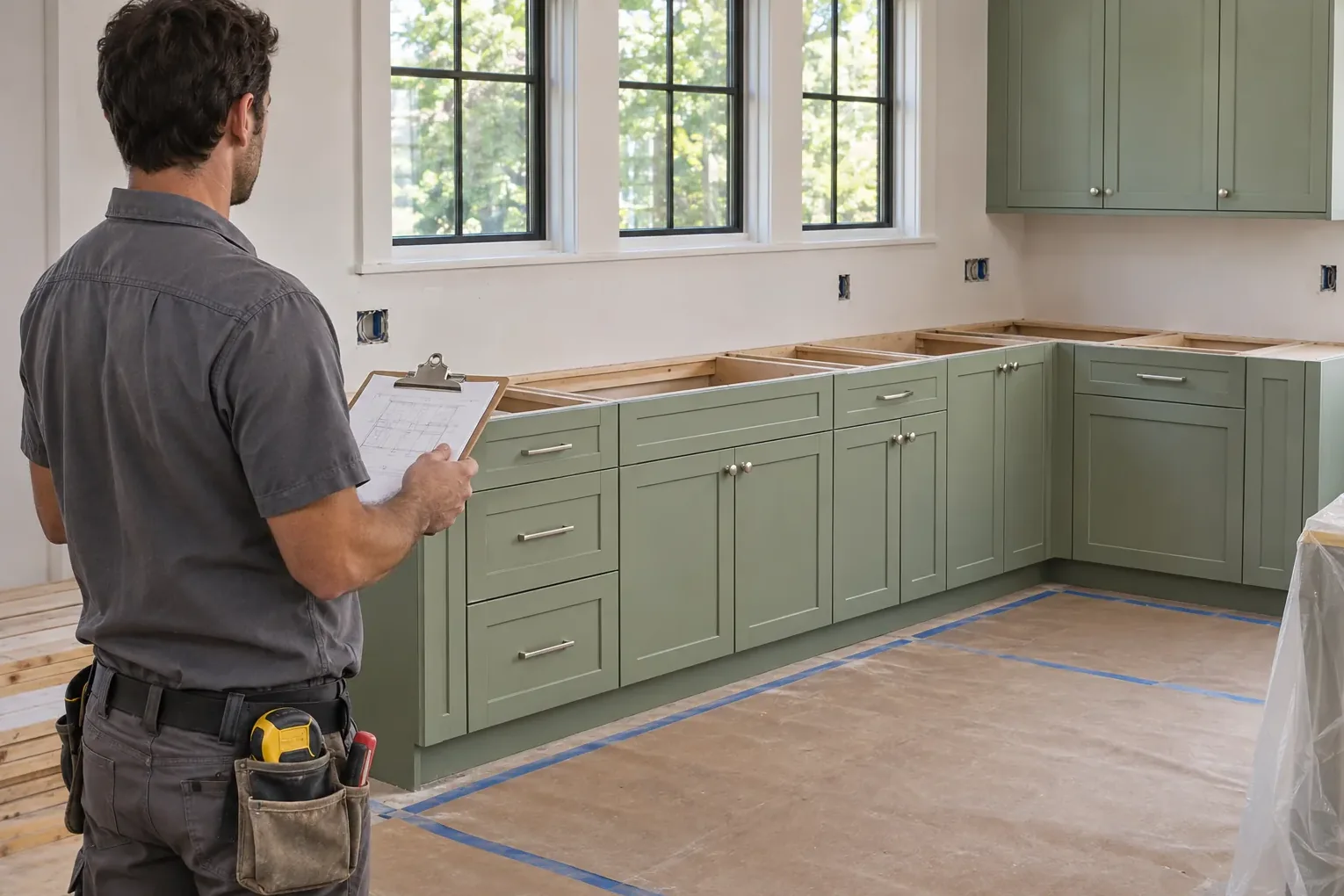
Hiring a Kitchen Contractor in Rockford, IL
Get a free quote
We reply with a price. Nothing is booked until you say yes.
Updated
What to expect
What you get when you hire us
Hiring a kitchen contractor should feel simple. Here is what we put on paper for every job, so you can compare us to anyone else.
- A written contract with the total price and the materials listed by name, before any work starts.
- A payment schedule tied to finished stages, with a small deposit.
- The permit line spelled out: which permits the job needs and who pulls them.
- Proof of insurance you can hold in your hand, ours and any subcontractor's.
- Lead-safe work practices in any house built before 1978.
- Hidden problems behind the walls priced in writing before we do that work.
Every kitchen is priced after we see it. If you are comparing bids, send us the other quote and we will read it with you.
What Illinois licenses and what it does not
General contractors are not required to be licensed in Illinois, though they may need a permit from the town. Rockford says the same on its permit page. So a company can say "licensed and insured" and mean only that it has a business registration and a policy. The word "licensed" by itself tells you very little in a kitchen job.
The trades inside the job are a different story. In Illinois, plumbing is done by licensed plumbers. Rockford does not license electricians, but it asks them to register with the city every year. Roscoe's municipal code lists a contractor registration section, so ask your village hall what it asks of a contractor. Your local village hall or township can also tell you about license rules and past complaints.
That makes the license question three smaller questions. Who does the plumbing? Who does the wiring? Who pulls the kitchen remodel permits? Get a name for each one before you sign.
Insurance and lead-safe certification
The Illinois Home Repair and Remodeling Act sets insurance minimums for a remodeler: $100,000 per person and $300,000 per occurrence for bodily injury, and $50,000 per occurrence for property damage, unless the business has a net worth of $1,000,000 or more. Ask for copies of the proof of insurance. Ask your own insurer whether you are covered for injury or damage on the job.
The second certificate to ask for is lead-safe. In a house built before 1978, anyone paid to disturb paint has to be EPA lead-safe certified, sole proprietors included. In Rockford 74.3% of homes were built in 1979 or earlier, so this comes up on most jobs here. Demolition of painted surfaces is always covered, however small. Our page on an old house kitchen remodel goes into what opens up behind those walls.
Check a company before the first visit
Do the homework before anyone stands in your kitchen. Check complaint records with the Illinois Attorney General and the Better Business Bureau. Get recommendations from friends, neighbors or coworkers who had similar work done. Ask for the names of suppliers and whether the contractor pays them on time. Call your local building department about permit and inspection requirements. And be wary of any business that operates out of a post office box, a private mailbox or a suite instead of a local business address.
Ask the same about subcontractors. Will any be used? Can you meet them? Do they carry current insurance and licenses? Did this contractor pay them on time in the past? That last question matters more than it sounds, because an unpaid subcontractor can put a lien on your house even after you paid the contractor in full. The lien side is explained on the kitchen remodel contract page.
A written estimate should be specific enough to compare. Look for the scope in words, the cabinet line and counter material by name, who handles demolition and haul-away, which permits are included, and what is left out. If one bid is thousands lower, it usually leaves something out, and a line-by-line read shows what.
Red flags that show up before you sign
The Illinois Attorney General gets more than 20 thousand complaints a year, and about 20 percent of them involve disputes with home repair contractors. The warning signs are short and specific:
| Red flag | Why it matters |
|---|---|
| Shows up uninvited or says a repair is urgent | Pressure replaces comparison. A real hazard still waits for a second estimate. |
| Pressures you to sign today | You have the right to read a contract and take it home. |
| A price far out of line with other estimates | Usually a different scope, or work that gets added later as extras. |
| Asks for the whole job up front | Nothing is left to hold the work to the schedule. |
| Only a PO box, mail drop or answering service | Hard to find if the job stalls. The state requires a business address on the contract. |
| Asks you to pull the permit | A common scam sign. |
| No written contract or no certificate of insurance | Required by law over $1,000, and the certificate is easy to produce. |
One more: no recent customer who will let you see the finished work. Ask references whether you may visit, whether there were unexpected costs and whether workers showed up on time.
Deposits and payment schedule
Illinois sets no cap on deposit size. The law covers what the contract must say, not how much you pay at signing, so the schedule is something you negotiate. Keep the down payment as small as you can get and tie later payments to finished stages of the job. You can also put the contract money with an independent escrow agent such as a bank or title company, so payments release as work is done. Do not pay the full amount up front, and do not make the final payment until the work is done and you are satisfied.
Write the schedule into the contract with the stage that triggers each payment. Cabinets delivered and inspected, rough plumbing and electrical passed, counters set, final walk-through. The kitchen remodel contract page walks through draws, change orders and lien waivers.
If your contractor stops showing up
First, stop paying ahead of the work. Then put everything in writing. Follow every phone call with a letter that summarizes it, sent by certified mail with a return receipt, and keep copies. Photograph the job as it stands, keep a log of dates, and save the contract, change orders and messages in one folder.
If the contractor does not start or finish in the contracted time, you may cancel and may be entitled to a refund of the down payment on written demand by certified mail. You can also file a complaint with the Attorney General's office for mediation. For smaller sums, Illinois small claims court hears cases up to $10,000. Small claims only awards money, and a business may need a lawyer to answer. For larger sums, talk to an attorney before you pay anyone else to finish the work.
Illinois also treats certain contractor conduct as a crime, such as knowingly misrepresenting terms or taking money for work the contractor does not intend to do. That is a matter for the police and the Attorney General, not something to argue in a text thread.
Why a low bid is not automatically a good one
Labor in Rockford is not cheap by national standards. Construction and extraction work in the Rockford metro averages $37.30 an hour, against $31.42 nationally. Rockford carpenters average $36.17 an hour, electricians $43.10 and plumbers $43.19. A bid that looks far below the usual ranges deserves a question about what has been left out.
Big box store, designer or a local crew
A kitchen can reach you three ways. A big box store sells the cabinets and counters and arranges the install. A designer or design-build firm draws the plan and manages trades. A general contractor or small crew runs the job directly. None of these is automatically better. What changes is who you are contracting with, who installs, and who answers the phone after.
Ask the same questions of all three. Who exactly installs, and is their insurance in the paperwork? Who pulls the permit? What happens if a cabinet arrives damaged or a countertop is cut wrong? Where do change orders go? A designer's fee is a separate line, typically $65 to $250. See the kitchen remodel cost page for the rest of the price list.
Hiring each trade yourself can save the manager's cut. It also makes you the manager, so you carry the sequencing, the permit and the gaps between trades. Our DIY kitchen remodel page covers what an owner can legally do.
Questions to ask every bidder
- Which permits does this job need in my town, and who pulls them?
- Can I have your certificate of insurance, and the subcontractors' too?
- Is your firm EPA lead-safe certified? (Required in a pre-1978 house.)
- Who does the plumbing and who does the wiring, by name?
- What is the payment schedule, and what has to be finished before each payment?
- How are things found behind the walls priced, in writing, before the work?
- Where are the consumer rights pamphlet and the acknowledgment form?
- May I see a finished kitchen and talk to that owner?
Get at least three written estimates based on the same work, so you can compare like with like. The cheapest bid is rarely the one with the most in it. If you already hold a quote, the free quote check reads it line by line, and our budget kitchen remodel page shows what different budgets buy.
Sources (13)
- Illinois Home Repair and Remodeling Act, 815 ILCS 513
- Illinois Home Repair Fraud Act, 815 ILCS 515
- City of Rockford, Building Permits
- City of Rockford, Electrical Permits
- Illinois Plumbing License Law, 225 ILCS 320/3
- EPA, Renovation, Repair and Painting Program: contractors
- U.S. Census Bureau, ACS 2020-2024 5-year, via Census Reporter
- Illinois Attorney General, how to choose a home repair contractor
- Illinois Attorney General, Home Repair and Construction: What You Should Know
- FTC, How To Avoid a Home Improvement Scam
- Illinois Legal Aid Online, small claims basics
- HomeAdvisor, kitchen remodel cost
- BLS, Occupational Employment and Wages in Rockford, May 2025
Want a straight price on yours?
Call, text a photo of the kitchen or of a quote you already have, or send the form. The price comes first, in writing.
Questions people ask
Is there a contractor license in Illinois?
Not for general contractors. Illinois does not require them to be licensed, though they may need a permit from the town. Plumbers are licensed by the state, and Rockford asks electricians to register each year. What protects an owner is the written contract the Home Repair and Remodeling Act requires over $1,000. See hiring a kitchen contractor above and the contract page.
How much deposit is normal for a kitchen remodel?
No Illinois law caps the deposit, so it is negotiable. Keep the down payment as small as you can get and tie later payments to finished stages. Never pay the whole job up front. The contract page shows a sample draw schedule.
What should I do if my contractor disappears after taking a deposit?
Stop paying, write to the contractor by certified mail with a return receipt, and keep copies and photos. Illinois guidance says you may cancel if the work does not start or finish on time and ask for a refund of the down payment in writing. You can file a complaint with the Attorney General, and small claims court takes cases up to $10,000. A lawyer helps for larger amounts. Prices for the job itself are on the cost page.
Do kitchen contractors need insurance in Illinois?
Yes under the Home Repair and Remodeling Act, which sets minimums of $100,000 per person and $300,000 per occurrence for bodily injury and $50,000 per occurrence for property damage, unless the business has a net worth of $1,000,000 or more. Ask for the certificate itself.
Is a big box store a safe way to remodel a kitchen?
It can be, if you know who installs and whose insurance covers the work. Ask who pulls the permit, who comes back if a cabinet is damaged, and whether the contract carries the same written details the Illinois law requires. The price of the job still belongs on the cost page for comparison.
Should I pick the lowest bid?
Only after you confirm the bids cover the same work. Get at least three written estimates based on the same scope, and do not automatically pick the lowest. A free quote check lines up what each one leaves out.
Does my contractor need to be lead-safe certified?
In a house built before 1978, yes. Anyone paid to disturb paint must be EPA lead-safe certified, sole proprietors included. Most Rockford homes fall near that line, so ask for the certification before demolition.
Keep reading
Hiring a kitchen contractor: get a written price
Tell us what you want to change and your town. We reply with a price, and no work starts until you agree to it.
Prices and the full service list are on the homepage for kitchen remodeling in Rockford.